
Can You Get Lived-In Blonde in a Two-Hour Appointment?
Two hours is enough to apply lightener, but a finished lived-in blonde needs most of a day. Lived-in blonde looks soft and unplanned, so people assume it's quick. It isn't.
At Sara Carden Hair in Austin, we build it in stages, and each stage needs its own time. Rushing any one of them is where most disappointing color comes from.
Is two hours enough for a lived-in blonde?
No, not from most starting points. A lived-in blonde takes most of a day, because lightening, blending, toning, and a finishing cut each need their own time. Two hours can cover a gloss, a toner refresh, or a few face-framing pieces on hair that is already light. It can't cover a first-time blonde.
Fast color has its place. Sara has worked fashion week runways and red carpet events, where a look has to hold for a show. Your blonde has to hold for months, in daylight, up close. Those are different jobs, and the second one can't be rushed.
A first-time blonde on dark or previously colored hair commonly runs three to five hours in the chair. Some run longer. Where yours lands depends on what we find at your consultation. Nobody can give you an honest number before looking at your hair.
What makes lived-in blonde take longer than it looks?
Soft color takes more steps than bold color, because every edge has to disappear. A hard line is easy to paint. A blend that grows out for months without a stripe is harder.
We paint lightener freehand, which is what balayage means: hand-painted, not packed into foils. Sections are small and placed where your hair would catch light on its own. Where a section needs more lift than paint alone will give, we add foil (that's foilage).
Then there's scalp heat. Roots process faster than ends because your head warms the lightener. So the lightener goes on in a deliberate order, and we check strands as we go instead of trusting a timer.
The root is its own step. A soft root smudge, toned a shade or two deeper than the lightened pieces, is what makes color look lived in. Skip it and you get bright blonde that starts a hard inch from your scalp.
Last comes toner. Lightener leaves hair pale yellow or gold. The toner decides the final shade.
What happens in the chair, start to finish?
A full lived-in blonde runs through six steps, and none of them can be skipped without showing later.
- Talk first. We look at your hair in natural light, ask what has been on it, and go through your photos. We tell you what will work, what won't, and why. You should leave this step knowing whether it's one visit or two.
- Map the placement. We decide where the light goes: around your face, along your part, through the lengths where sun would hit. A good map leaves some of your natural depth alone.
- Paint the lightener. It's freehand balayage, with foil where a section needs it. The lightener feathers softly at the root and builds toward the ends.
- Process and check. We check strands for lift instead of watching the clock. You want pieces that reach pale gold evenly, not orange in one spot and white in another.
- Rinse, tone, and shampoo. Toner sets the shade, then comes a shampoo and scalp massage. The color should read cool, neutral, or warm because you chose it.
- Cut and style. Sara is a straight-razor specialist, so the finishing cut can soften the ends and let the blonde move. We also show you how to style it for day five, not just day one.
Why does warm hair take longer to go cool, bright, and dimensional?
Warm-leaning hair carries extra orange and gold pigment. That pigment has to be cleared before the blonde can read cool, because toner can't cancel what the lightener hasn't cleared.
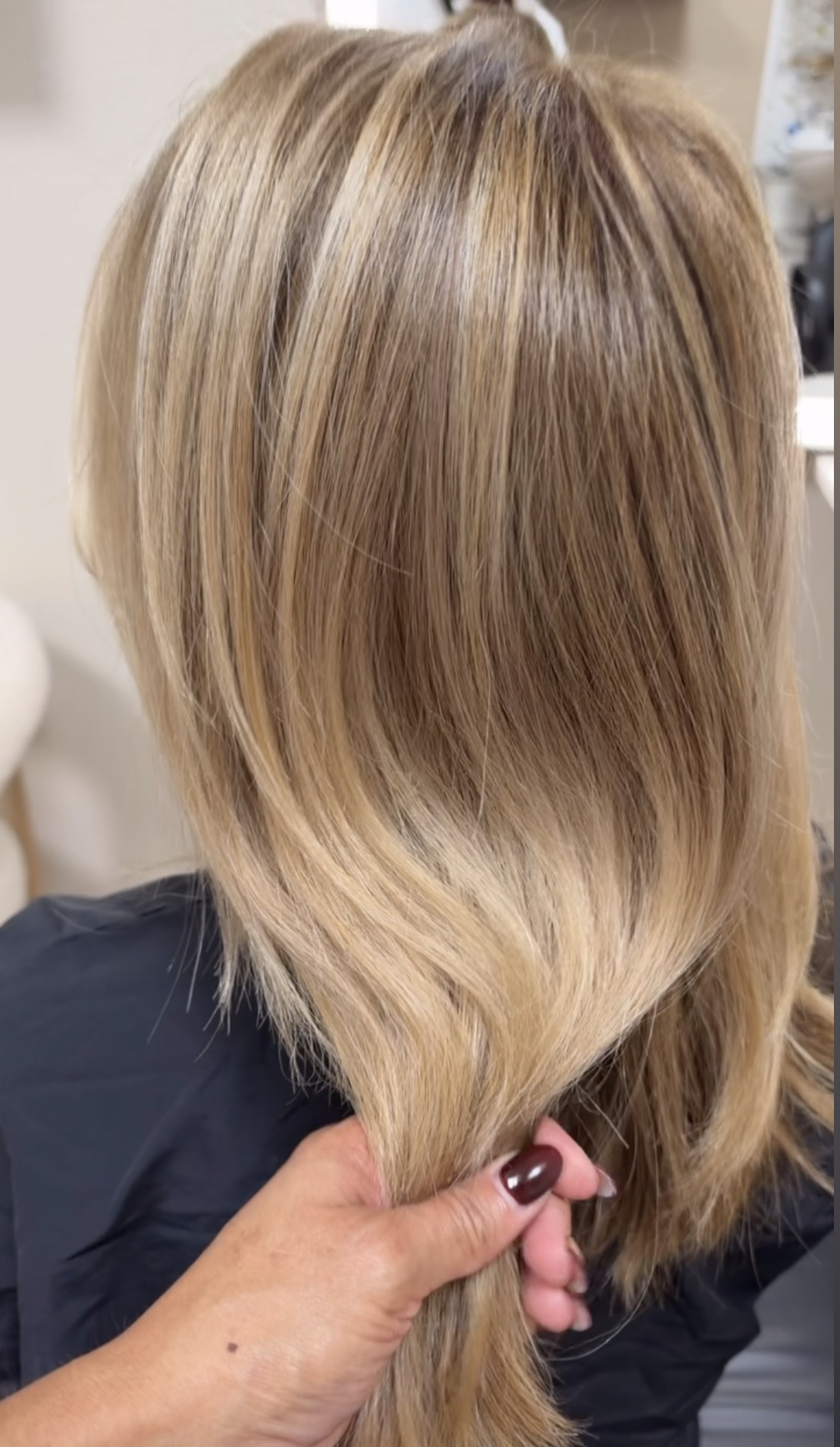
The client in the photo above came to us with hair that runs warm. They wanted three things: cooler, brighter, and dimensional. Those are three separate jobs.
Cooler
Cooler means lifting past the orange and yellow stages into a pale gold, then toning. Toner adds a touch of color. It can't remove warmth the strand still holds. Put a cool toner over hair that is still orange and you get muddy beige, or the warmth comes back within days.
Brighter
Brighter means clean lift in the right pieces, not every strand lifted as far as it will go. Push all of it and the hair pays in breakage. The blonde looks flat anyway.
Dimensional
Dimensional means leaving depth between the light pieces. Light next to dark is what makes blonde look like it has movement. So we hold some of your natural base back, even when you've asked for bright.
Warm-leaning hair asks for all three at once. The lightening has to go far enough to read cool without going further than your hair can take. That balancing act is why this color is not a two-hour job.
Which blonde appointment are you booking?
Four different appointments all get called blonde. They don't take the same time, and they don't ask the same of your hair. Balayage, partial highlights, toner, and bleach and tone each have their own listing on our service menu.
Gloss or toner refresh
This is for hair that is already blonde and has drifted warm. It's the fastest of the four. It resets the shade and adds shine, but it won't make your hair lighter. It's also the visit you'll repeat most, because tone fades before the lightening does.
Partial balayage or partial highlights
This lightens the top sections and the pieces around your face and leaves the underneath alone. It suits light brown hair, hair with some blonde already in it, or anyone who wants a softer change. Less of your head is lightened, so it grows out gently. It's shorter than a full session, but it's still not a quick stop.
Full lived-in blonde
This is the whole head, hand-painted, with the root blended, toned, and cut. It suits anyone who wants clearly blonde, dimensional hair. It's the appointment described in the six steps above. Most clients go three to four months between full sessions, with a toner refresh in between.
Bleach and tone from dark or previously colored hair
This is the longest one. Dark natural hair, black dye, box dye, and layers of past color all hold warm pigment, and lifting them takes patience. Sometimes the honest plan is two visits so your hair stays strong. We'll tell you at the consultation which one you're looking at.
What changes the quote is length, density, starting color, and time in the chair. Pricing varies by consultation, and our service menu lists current starting prices.
What goes wrong when blonde is rushed?
Rushed blonde usually skips one of three things: the consultation, the lift check, or the toner. Each skip leaves a mark you can see.
Skip the consultation and lightener goes over old dye you didn't mention. The old color lifts in patches. Skip the lift check and the roots go bright yellow while the ends stay orange. Stylists call that hot roots.
Skip the toner and the blonde turns yellow and brassy within days. We break that pattern down in why highlights look yellow.
Then comes the fix. Redoing blonde takes more time than doing it right the first time, and hair lightened twice in a week has less left to give. Color corrections are a full-day commitment. Bring snacks and a book.
There's one more thing people get wrong: they judge by the photo. A photo shows where someone ended, with no sign of where they started, how many visits it took, or what their hair could take. Bring the photo anyway. We'll use it to talk about your starting point.
How long does lived-in blonde last, and what keeps it pretty?
Lived-in blonde grows out without a line, so it lasts longer between visits than blonde that starts at the scalp. Most stylists see clients go three to four months between full lightening sessions. Yours lands closer to the low end or the high end depending on how fast your hair grows and how light you go.
Tone is what fades first. Hill Country water tends to pull blonde warm, and sun adds to it. We walk through the water side of this in why your blonde fades fast in Driftwood. A gloss between full sessions keeps the shade where you chose it.
At home, a little purple shampoo goes a long way. Most people overdo it, so use it sparingly and read how to use purple shampoo the right way. We use and retail Evo Hair (EU-certified, no sulfates, no parabens), Amika, Aluram, and Shibui. Blonde clients ask whether Aluram only suits curls. It works on blonde balayage too.
Heat tools are the other thing to plan for. Ask us before you leave which leave-in from those four lines fits your hair and how you style it. Your home routine should match the blonde you just sat for.
You can see how soft roots grow out on our Instagram. Good lived-in color looks good on day one and still looks good at week ten.
Who is lived-in blonde not right for?
Lived-in blonde is not for you if you want icy platinum with a razor-sharp root. That look needs frequent root touch-ups, and it is not low maintenance.
It's also not right yet if your hair is breaking or carries several layers of box dye. We'd rather tell you to wait, or stage the work over a few visits, than lift hair that can't take it. Telling you what won't work is part of the job.
And if you need blonde by a date two days away, say so when you book. Sometimes a gloss and a few face-framing pieces will get you there. A full blonde in that window would cost you your hair's condition.
One last note. Low maintenance is what lived-in color is built for, and that part is real. No maintenance is not.
Frequently Asked Questions
How long does a lived-in blonde appointment take?
A first-time blonde commonly runs three to five hours in the chair, and dark or heavily colored hair can run longer. A gloss alone takes far less time. We'll give you a realistic plan at your consultation, once we've looked at your hair.
Can balayage work on dark hair?
Yes, with the right expectations. Dark hair can take more than one visit to reach a clean blonde. Going slower is how you keep the hair strong and the blonde clean.
How do you pronounce balayage?
It's bah-lee-AHZH. The word is French for sweeping, which describes how the lightener is painted on by hand.
What is the difference between balayage and ombre?
Balayage blends light pieces through the hair with no hard line, so it looks like the sun did it. Ombre moves from dark at the root to light at the ends in a clear gradient. Balayage grows out softer, while ombre shows a deliberate line.
Is balayage good for curly hair?
Yes. Hand-painting works well on curls because the color follows the curl pattern instead of fighting it. Curly hair also tends to run drier, so we pay close attention to how much lift it can take.
What is a reverse balayage?
Reverse balayage adds darker pieces back into hair that has gone too light or too flat. It brings depth back and breaks up blonde that was lifted everywhere. It's one of the ways we fix an over-lightened result.
Does caramel balayage count as lived-in blonde?
Yes, it can. Caramel is a warm tone, so it suits people who like gold in their color. If you want cooler, brighter blonde, we'd tone toward neutral or cool instead.
Should I balayage my hair?
Yes, if you want soft, dimensional blonde that grows out without a harsh line. If you want solid platinum from root to tip, or zero upkeep, probably not. We'll tell you which one you are at your consultation.
Book a Consultation
Blonde starts with a conversation, not a timer. At Sara Carden Hair, inside Marquise Salon Suites off West Highway 71 in Oak Hill, every appointment is one-on-one. No double-booking, no assistants.
Clients come to us from Austin, Bee Cave, Lakeway, and Dripping Springs. We'd rather give you the honest plan than a short one. Thursday and Friday run 9 am to 5 pm, which leaves room for a longer blonde.
Book your blonde consultation, or call (714) 356-9500. Bring photos, and plan to stay a while.